product background
Skip to product information

Colombia

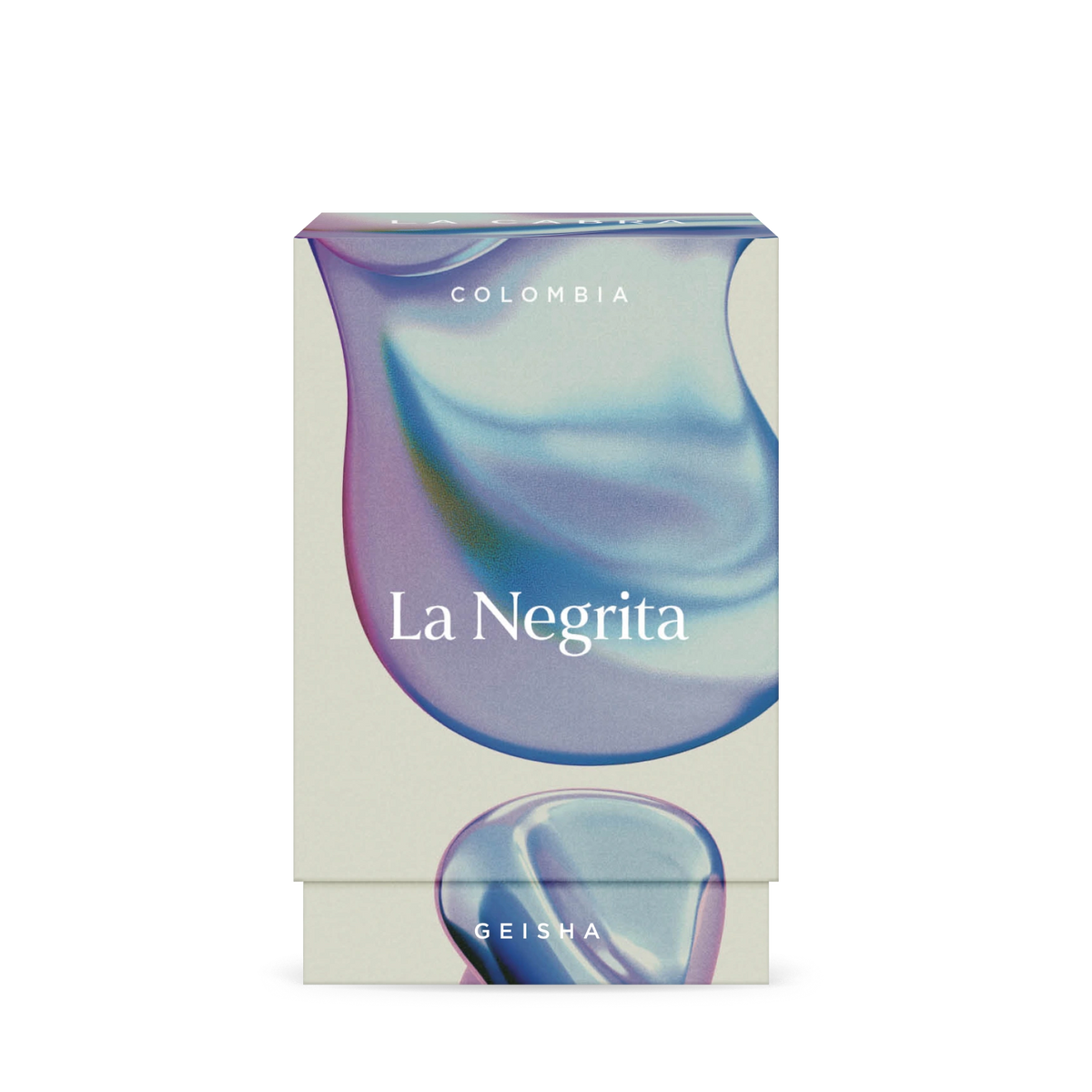
La Negrita

La Negrita

Perfumed florals, layered citrus and honey in this lot from one of the highest plots of Mauricio Shattah’s iconic Finca La Negrita.

Amount

Regular price Kr. 469,00 DKK
Kr. 469,00 DKK Regular price Sale price
incl. vat/tax
View full details

About

Coffee Expression We find delicate and clear white florals in the aroma, before a layered, juicy and sweet cup with notes of fresh lemon balm, oolong tea and a floral honey finish.

Producer Mauricio Shattah has developed a truly impressive approach to hyper-specialty lots, processed to order for discerning clients.

Whole Bean Coffee / Both for filter and espresso

Technical Data

Producer Mauricio Shattah

Region Tolima

Altitude 2100 masl

Varietal Geisha

Process Honey

Harvest August 2026

Brewing Advice

Water is one of the most critical components of an excellent coffee experience. We recommend using mineral water of a soft Total Dissolved Solids count, ideally below 50 ppm. 

Rested coffee During the resting process, harsh and astringent flavors, which can even be perceived as a ‘roast’ character, soften out, allowing a clearer and brighter expression of the coffee’s character to shine.  

We recommend resting our coffees for at least 10 days after the roast date, and we often find excellent results, especially for particularly dense coffees, beyond 6 weeks.

Brewing Our straightforward approach to coffee carries over into brewing. We recommend our roasted coffee for all brew methods, regardless of whether it is immersion, percolation or espresso. We believe that there is one correct way to roast a single coffee, roasting lightly, in such a way as to release its innate qualities and showcase its quality. Learn more about different brewing techniques and specific brew guides here.

Shipping & Delivery

· Free shipping available

· Ships within 1-3 days from Denmark

· More info

Mauricio Shattah

Mauricio Shattah has an incredibly meticulous approach to coffee production, influenced by his past as an oncologist in the United States. His scientific background and constant hunger for improvement have led to a unique and considered method, reflected in the stand out coffees we have consistently tasted from La Negrita.

A long time coming

Our relationship with Mauricio began in 2017, when we purchased our first lot from the farm. After that first experience with his phosphoric acid process Geisha, we met again in Copenhagen the following year, then made the trip to visit La Negrita late in 2019. Since reconnecting after Covid-19, we've been sharing Mauricio's coffees again, and this year we're excited to bring you a lot from his August harvest. This coffee is a red honey with a special twist: it goes through a yeast-controlled fermentation, a great example of the hyper-specialty approach Mauricio has developed at La Negrita, where lots are processed to order for discerning clients.

Finca La Negrita

After returning to Colombia from the US, Mauricio and his wife Liliana Montoya ran coffee shops together with Liliana’s brother, but yearned for the countryside, for fresh air and a connection to the land. Therefore, in order to combine their passions, they purchased a coffee farm in Tolima, just a short drive out of the regional capital of Ibague. Finca La Negrita is located in Villa Restrepo, on the fertile volcanic slopes of Nevado del Tolima, which peaks at 5276 masl. It was here that Mauricio developed his approach, reading scientific papers on fermentation, and engaging experts from across the agricultural world, both within and outwith coffee.

Work in the field

Each stage of production is taken care of with the utmost level of care and attention, from planting the first seedlings, to dry milling and export. Mauricio has developed a bespoke fertilisation procedure, mainly relying on organic methods; creating bacteria-rich fertilisers in bio-reactors, and farming worms within waste coffee pulp to fix nutrients and nitrogen into the soil. Trees are planted at specific spacings depending on varietal, and plant material is kept young and vigorous through careful pruning and renewal regimes. The conditions here, high on the volcanic slopes, mean incredibly slow production, and low yields that are spread across much of year. Trees here take nearly twice as long to produce as they would at lower altitude near Armenia, meaning cherry maturation is long, and the plant’s energy is concentrated into a small number of cherries over a longer period of time.

This lot has in fact been grown on the highest plot of the farm, known as ‘Nevado’, at over 2100 masl. Combined with Mauricio’s extreme degree of care, this leads to an incredibly high quality of raw material.

Meticulous processing

This raw material is then subject to some of the most meticulous processing we have seen during our time on coffee. Cherries are first floated in a very weak chlorox solution, removing almost all of the native bacteria and yeast from their surface, while also sorting for low density and defective cherry. Each varietal Mauricio grows is then subject to its own fermentation routine, creating an opportunity for intentional flavour manipulation. In the case of this honey lot, these very clean cherries are rested for 24 hours, before de-pulping and sealing in stainless steel tanks, inoculating with saccharomyces yeast and fermenting under anaerobic conditions for 48 hours. Mauricio has found that excess CO2 pressure can lead to carbonic acid taints in the cup, so flushes with nitrogen every three hours during fermentation, to minimise the effect of the CO2 as much as possible.

Precision drying

After this, the lots are dried with a similar level of precision. Mauricio places coffee in small dark rooms which he refers to as 'toll booths', completely shaded from UV light using black fabric. This fabric allows radiant heat to enter the room, but not direct light, protecting the fragile seed and locking in flavour. The coffee dries very slowly over 6 weeks, with airflow and humidity manipulated using fans and de-humidifiers during the entire drying process. During this time, coffee is turned and manually sorted twice a day, meaning each lot can be hand-picked over 80 times. This incredible level of attention to detail has led to this honey lot, picked in August 2026, fermented, dried and rested for 4 weeks before being ready to ship to us in Copenhagen. We find delicate white florals in the aroma, before a layered, juicy and sweet cup with notes of lemon balm, oolong tea and a floral honey finish.

You might also like