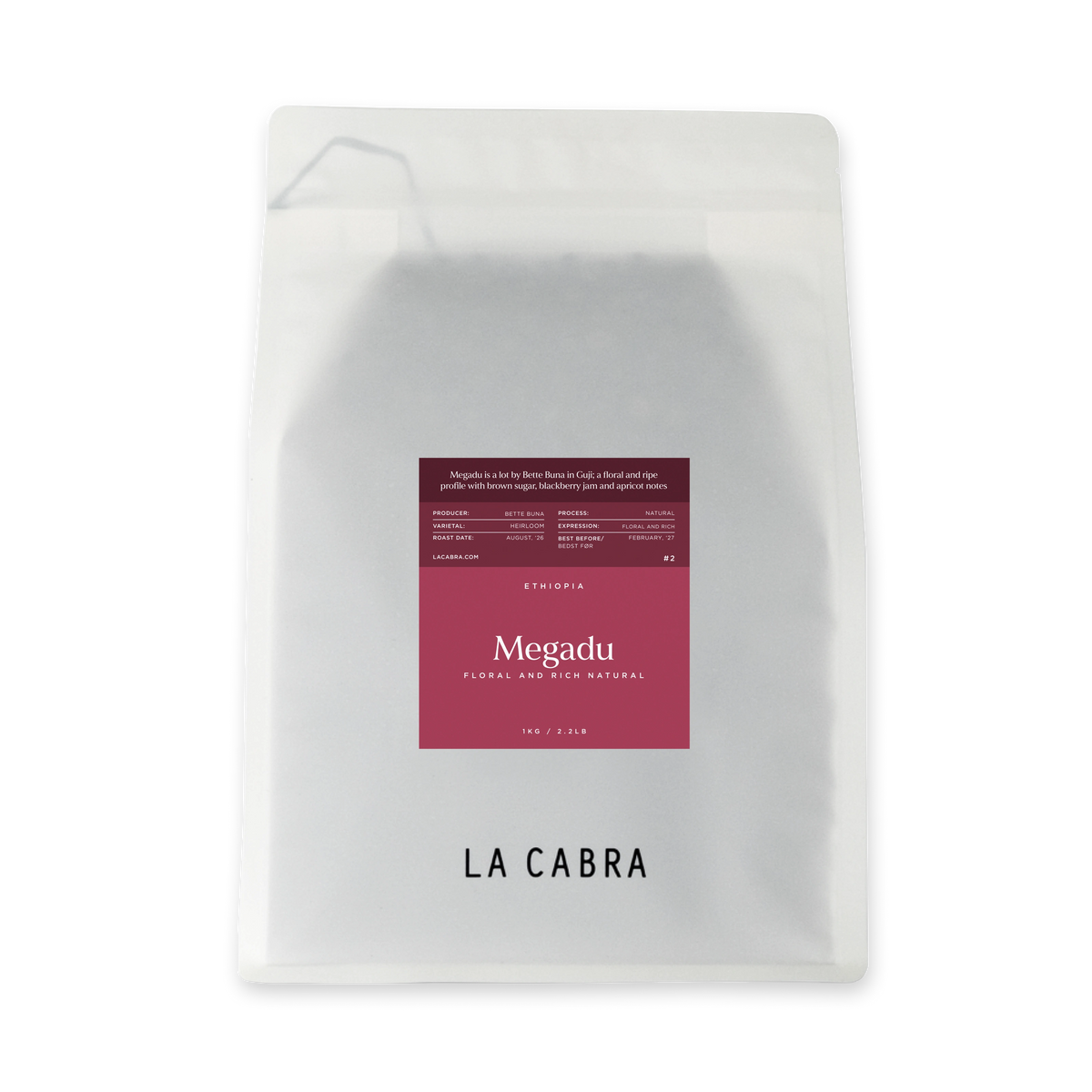
Megadu is a lot by Bette Buna in Guji; a floral and ripe profile with brown sugar, blackberry jam and apricot notes.
About
Coffee Expression This lot by Bette Buna has a floral and ripe profile with brown sugar, blackberry jam and apricot notes.
Producer Bette Buna is Amharic for ‘the house of coffee’; the project was founded to make a real difference for the community that surrounds the farm.
Whole Bean Coffee / Both for filter and espresso
Technical Data
Producer Bette Buna
Region Guji
Altitude 2100 masl
Varietal Heirloom
Process Natural
Harvest December 2025
Brewing Advice
Water is one of the most critical components of an excellent coffee experience. We recommend using mineral water of a soft Total Dissolved Solids count, ideally below 50 ppm.
Rested coffee During the resting process, harsh and astringent flavors, which can even be perceived as a ‘roast’ character, soften out, allowing a clearer and brighter expression of the coffee’s character to shine.
We recommend resting our coffees for at least 10 days after the roast date, and we often find excellent results, especially for particularly dense coffees, beyond 6 weeks.
Brewing Our straightforward approach to coffee carries over into brewing. We recommend our roasted coffee for all brew methods, regardless of whether it is immersion, percolation or espresso. We believe that there is one correct way to roast a single coffee, roasting lightly, in such a way as to release its innate qualities and showcase its quality. Learn more about different brewing techniques and specific brew guides here.

Bette Buna
Bette Buna was founded by Dawit and Hester Syoum in 2020. Hester is originally from the Netherlands; she and Dawit met while they were working together in Ethiopia for an NGO.
Dawit has a long family history in coffee, having grown up in Sidamo around his grandparents farm. His grandparents had always been seen as leaders in the community, so when they died, he and Hester took over the family farm, continuing the farm’s legacy as a safe haven for all, where all neighbours could feel at home. Hester and Dawit brought their experience in capacity building with communities across Ethiopia, and began to build Bette Buna, Amharic for ‘the house of coffee’, as a project to make a real difference for the community that surrounds the farm in Taferi Kela, Sidamo.
Megadu
This lot is from Hester and Dawit’s newer project in Guji, near the village of Megadu, in the Shakiso sub-region. This area is densely forested; coffee has grown here for centuries, both wild and cultivated. Although Guji is just across the border from Dawit’s home region of Sidamo, the culture here is rather different, so Bette Buna allied with two local community leaders to start their project, on 220 hectares of land just outside Megadu. Hester and Dawit currently administer 50 hectares of the land, and process coffees from the wider plot and from neighbours for export. For some community members, they have even built small drying facilities on their land, or organised them into groups to share a miniature drying station. Each farmer also receives training on cherry selection, quality and drying. This capacity building allows producers to take more control of their supply chain, building a more finished product and allowing them access to the speciality market.
A community project
This particular lot is composed of cherries exclusively from the land of Saffay, one of the leaders in the community. Saffay is now able to dry cherries on his own land due to the work he has accomplished together with Bette Buna, producing his own high quality lots. This leads to a floral and ripe profile with brown sugar, blackberry jam and apricot notes.
Ethiopia
In Ethiopia, coffee still grows semi-wild, and in some cases completely wild. Apart from some regions of neighbouring South Sudan, Ethiopia is the only country in which coffee is found growing in this way, due to its status as the genetic birthplace of arabica coffee. This means in many regions, small producers still harvest cherries from wild coffee trees growing in high altitude humid forests, especially around Ethiopia’s famous Great Rift Valley.
Forest coffee makes up a great deal of Ethiopia’s yearly output, so this is a hugely important method of production, and part of what makes Ethiopian coffee so unique. Deforestation is threatening many of coffee’s iconic homes in Ethiopia, leading to dwindling yields and loss of biodiversity; significant price fluctuations over the past decade have led many farmers to replace coffee with fast growing eucalyptus, an incredibly demanding crop in terms of both water and nutrient usage.
Throughout these endemic systems, a much higher level of biodiversity is maintained than in modern coffee production in much of the rest of the world. This is partly due to the forest system, and partly down to the genetic diversity of the coffee plants themselves. There are thousands of ‘heirloom’ varieties growing in Ethiopia; all descended from wild cross pollination between species derived from the original Arabica trees. This biodiversity leads to hardier coffee plants, which don’t need to be artificially fertilised. This means that 95% of coffee production in Ethiopia is organic, although most small farmers and mills can’t afford to pay for certification, so can’t label their coffee as such. The absence of monoculture in the Ethiopian coffee lands also means plants are much less susceptible to the decimating effects of diseases such as leaf rust that have ripped through other producing countries. Maintaining these systems is important, both within the context of the coffee industry, and for wider biodiversity and sustainability.

You might also like
-
Julian Calderón Pink Bourbon
Colombia | 200g, 1kgRegular price From Kr. 159,00 DKKFrom Kr. 159,00 DKK Regular priceSale priceincl. vat/taxUnit price / per -
Shantawene
Ethiopia | 250g, 1kgRegular price From Kr. 159,00 DKKFrom Kr. 159,00 DKK Regular priceSale priceincl. vat/taxUnit price / per -
Las Flores de Cafe
Guatemala | 250g, 1kgRegular price From Kr. 155,00 DKKFrom Kr. 155,00 DKK Regular priceSale priceincl. vat/taxUnit price / per -
Oma Natural
Ethiopia | 100gRegular price Kr. 229,00 DKKKr. 229,00 DKK Regular priceSale priceincl. vat/taxUnit price / per
Complete your setup
-
ZeroWater Pitcher
1.7L, 2.4LRegular price From Kr. 389,00 DKKFrom Kr. 389,00 DKK Regular priceSale priceincl. vat/taxUnit price / per -
Sold out
ZeroWater Replacement Filters
Regular price Kr. 359,00 DKKBuy 3 save 10%Kr. 359,00 DKK Regular priceSale priceincl. vat/taxUnit price / perSold out -
Mineral Drops
Regular price Kr. 259,00 DKKBuy 3 save 10%Kr. 259,00 DKK Regular priceSale priceincl. vat/taxUnit price / per -
Kinto Coffee Server
300ml, 600mlRegular price From Kr. 149,00 DKKFrom Kr. 149,00 DKK Regular priceSale priceincl. vat/taxUnit price / per -
La Cabra Coffee Server
Regular price Kr. 149,00 DKKKr. 149,00 DKK Regular priceSale priceincl. vat/taxUnit price / per -
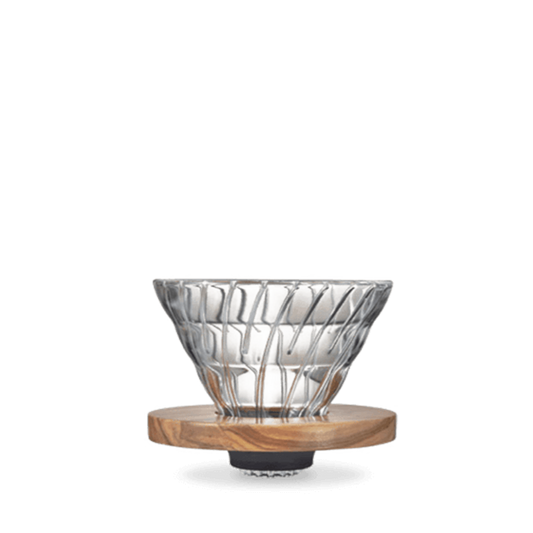
V60 Dripper - Wood
1 Cup, 2 CupsRegular price From Kr. 319,00 DKKFrom Kr. 319,00 DKK Regular priceSale priceincl. vat/taxUnit price / per -
V60 Dripper - Plastic
1 Cup, 2 CupRegular price From Kr. 39,00 DKKFrom Kr. 39,00 DKK Regular priceSale priceincl. vat/taxUnit price / per -
Sepia Kinto Coffee Server
300ml, 600mlRegular price From Kr. 229,00 DKKFrom Kr. 229,00 DKK Regular priceSale priceincl. vat/taxUnit price / per -
Cafec ABACA Filter Paper
1 Cup (for 1 cup), 4 Cups (for 2-4 cups)Regular price From Kr. 44,00 DKKBuy 3 save 10%From Kr. 44,00 DKK Regular priceKr. 0,00 DKKSale priceincl. vat/taxUnit price / per -
AeroPress Filters
Regular price Kr. 55,00 DKKBuy 3 save 10%Kr. 55,00 DKK Regular priceSale priceincl. vat/taxUnit price / per -
AeroPress Coffee Maker
Regular price Kr. 339,00 DKKKr. 339,00 DKK Regular priceKr. 0,00 DKKSale priceincl. vat/taxUnit price / per -
Hario Drip Scale
Regular price Kr. 549,00 DKKKr. 549,00 DKK Regular priceSale priceincl. vat/taxUnit price / per