product background
Skip to product information

Ethiopia

Shantawene

Shantawene

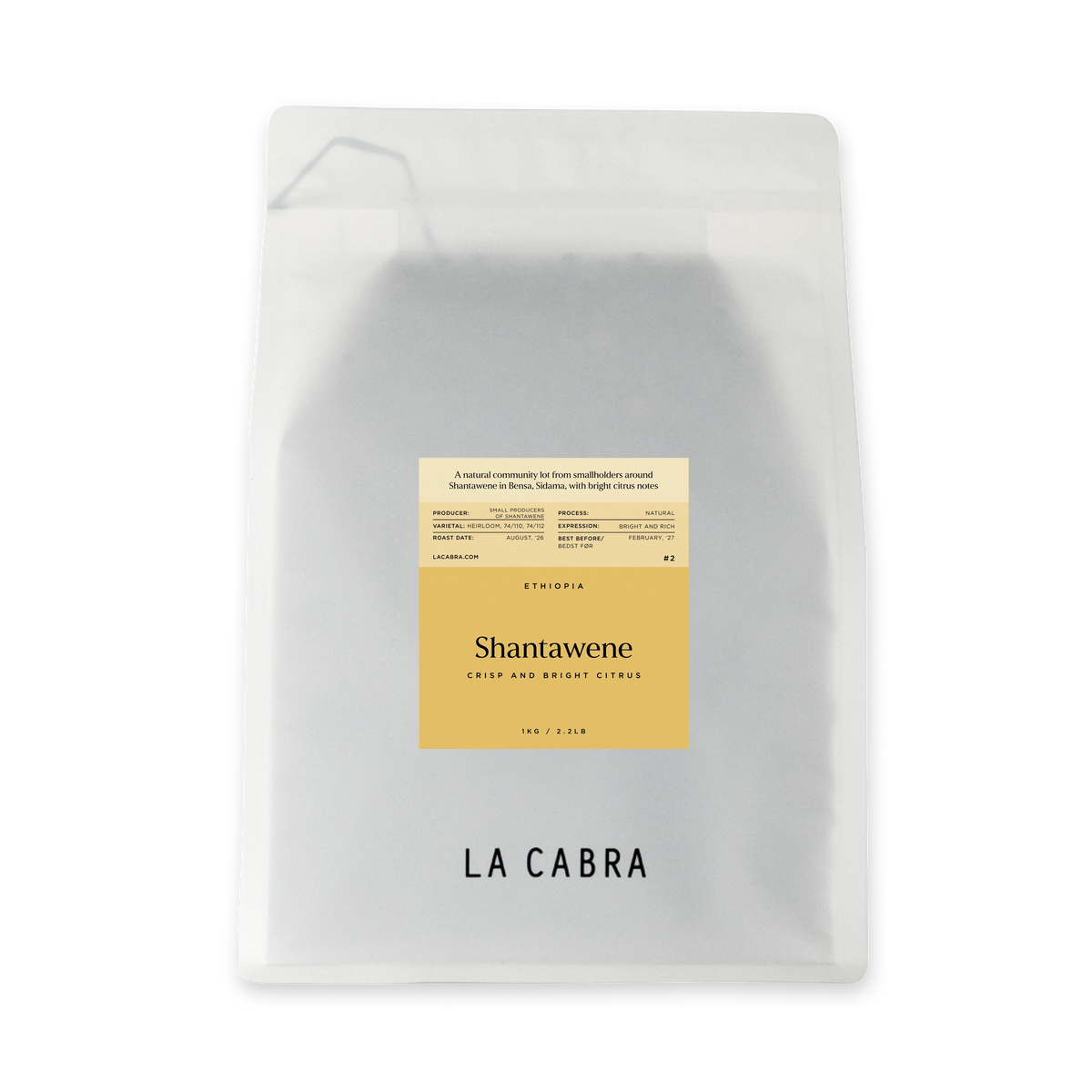
A natural-processed community lot from smallholder garden farmers around Shantawene in Bensa, Sidama, with a bright citrus character.

Regular price Kr. 159,00 DKK
Kr. 159,00 DKK Regular price Sale price
incl. vat/tax
Amount

About

Coffee Expression A natural-processed community lot with notes of bright citrus acidity from smallholder producers around Shantawene village.

Producer Grown by "garden farmers" on plots of around 1.5 hectares each, in the shade of native Wanza, Shola and Tsid trees.

Whole Bean Coffee / Both for filter and espresso

Technical Data

Producer Smallholder community of Shantawene

Region Sidama, Bensa District

Altitude 2.000 - 2.200 masl

Varietal Heirloom, 74/110 and 74/112

Process Natural

Harvest October - December 2025

Brewing Advice

Water is one of the most critical components of an excellent coffee experience. We recommend using mineral water of a soft Total Dissolved Solids count, ideally below 50 ppm. 

Rested coffee During the resting process, harsh and astringent flavors, which can even be perceived as a ‘roast’ character, soften out, allowing a clearer and brighter expression of the coffee’s character to shine.  

We recommend resting our coffees for at least 10 days after the roast date, and we often find excellent results, especially for particularly dense coffees, beyond 6 weeks.

Brewing Our straightforward approach to coffee carries over into brewing. We recommend our roasted coffee for all brew methods, regardless of whether it is immersion, percolation or espresso. We believe that there is one correct way to roast a single coffee, roasting lightly, in such a way as to release its innate qualities and showcase its quality. Learn more about different brewing techniques and specific brew guides here.

Shipping & Delivery

· Free shipping available

· Ships within 1-3 days from Denmark

· More info

View full details

Shantawene

Shantawene village sits between the small village of Bombe and Bombe mountain, in the Bensa district of Sidama. The producers behind this lot are part of the Shantawene Kebele community, where both Sidaamu and Amharic are spoken. Like most coffee growers in this part of Ethiopia, they are smallholders and locally referred to as "garden farmers", a term that reflects the way coffee is cultivated here: on small plots of around 1.5 hectares each, surrounding the homes where the producers live. Many of them also harvest cherries directly from trees growing wild on their own land. This natural occurrence of coffee trees in the birthplace of coffee, Ethiopia, is a testament to its rich coffee heritage.

The Bensa District is characterized by its ideal coffee-growing conditions. At altitudes between 2,000 and 2,200 masl, the coffee grows slowly on fertile clay soils, shaded by native Wanza, Shola and Tsid trees. The region has two distinct rainy seasons. The first, known as Belg, falls between late February and May, and the longer Kiremt spans from June to September. Together they bring around 1,200 mm of rain a year, contributing to the lush vegetation and fertile soil that are conducive to coffee cultivation.

The average temperature of around 22°C, combined with the altitude, allows the cherries to ripen slowly on the tree, developing the intensity and sweetness that natural processing brings out so well. At harvest between October and December, cherries are hand-picked at full maturity and moved directly to raised African beds, where they dry slowly under close attention. The cherries are then thoroughly sorted before warehousing.

This lot is composed of the Ethiopian heirloom varieties 74/110 and 74/112, and shows the character we look for in natural-processed coffees from Sidama: bright citrus acidity.

You might also like